How it works, and what it costs.
I design things to be built, and I hand you a package your shop can quote off and work from. I don’t bid the build, so I’m not competing with whoever you take it to.
A phone call
You describe the problem. I ask what it has to do, what it bolts to, and what happens if it stops. Costs nothing, and ends with me telling you whether it’s a fit.
Measure or scan
On site with a tape, or with a scanner when nothing around it was ever drawn. Sometimes photos and a few dimensions are genuinely enough.
Design, and a look at it
You see the model before it becomes drawings. Changing something on screen is free. Changing it after the plate is cut is not.
The package
Everything a shop needs to price it and build it without phoning me. Yours to take wherever you want.
What’s in a package
- The 3D modelThe real geometry, so it can be checked, modified later, or handed to the next person who needs it.
- Shop drawingsDimensioned and sequenced, with weld callouts. Written so a fabricator can start without a phone call.
- Cut filesReady for the table — plasma, laser or waterjet — in the format your shop runs.
- NestsParts grouped by material and thickness on blank sizes shops actually buy, so nobody is working out what to order.
- Hardware scheduleEvery bolt, bearing, bushing and fastener listed, with sizes, so purchasing has one list.
- Assembly orderWhere it matters — what goes together first, and what has to go in before something else blocks it.
A number before I start, not an invoice afterwards
Two stages, each with a fixed price you know before it starts. Nothing is billed by the hour, and no invoice turns up bigger than the conversation that preceded it.
- Stage one — assessment
$750 I come out and look at it. Measure what’s there, talk to the people who run it, and work out what the constraint actually is rather than what it looks like in a photo. You get a written problem definition, the recommended approach, and a fixed price for the package — yours to keep whether you go on or not. Further out, or where it needs an overnight, $1,500. - Stage two — the package
$1,800 – 8,000 Where most design packages land, depending on part count and complexity. The $750 comes off, so the package price is the whole price. Half to begin, balance on delivery. Full machines and multi-station systems get quoted on their own. - Smaller than that?
Still $750 $750 is the minimum on any job, and plenty of jobs are smaller than it. A single part — a cover, a bracket, a replacement nobody stocks any more — can be measured, drawn and placed with somebody who’ll make it for less work than a site visit takes. It’s still $750, and $750 covers the lot. - If I got it wrong A mistake in my drawing is mine to fix, and it costs you nothing. If what you want changes after the drawings are done — a different size, another station, a feature nobody mentioned at the start — that’s a change order, priced and agreed before I touch it.
Speed is a thing you can buy
What I don’t do
I don’t bid the build. The package is yours and you take it to whatever shop you want — including your own, if you have one. That’s deliberate: a designer who also wants the fabrication has a reason to draw it a particular way, and I’d rather you never have to wonder about that.
I’m also not a professional engineer. What I hand over is design and fabrication documentation, and none of it carries a PE seal. Where your code official, your permit or your insurer requires one, you’ll hear that from me on the first phone call rather than find it out at inspection — and I’ll work alongside whoever stamps it.
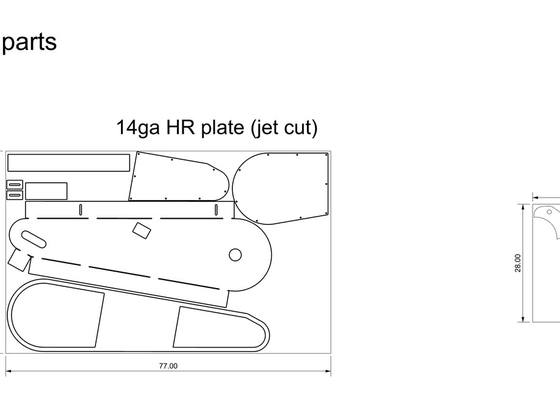 Nested to real stock
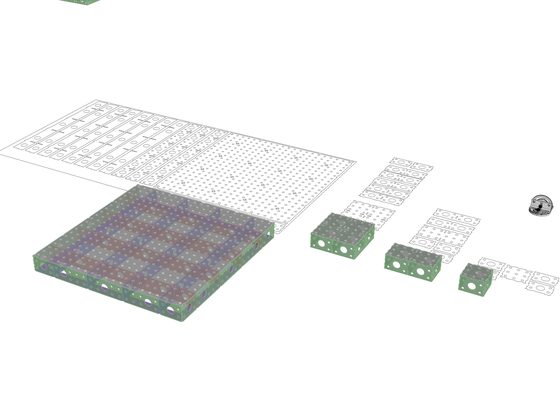 Every part, flat-patterned
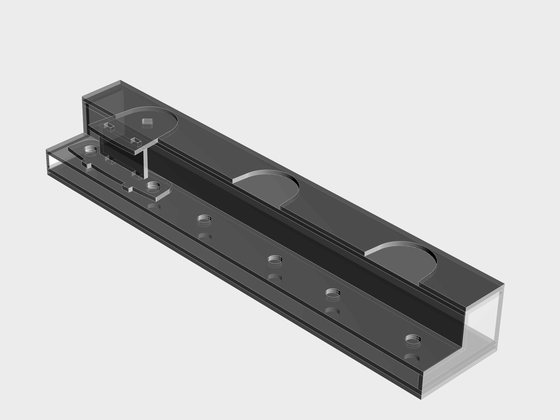 Tooling, when it pays for itself
Tell me what you’re trying to build
A phone call and a few photos is enough to know whether this is worth either of our time. If it isn’t, I’ll say so.